
Market Pulse September 2026
TSX pulls back amid higher yields, trade uncertainty
Canadian equities gave back some ground after a strong run earlier in the year, as the S&P/TSX Composite declined approximately 2.9% on a price-return basis. The Canadian economy, however, held up reasonably well. Real GDP grew at a 3.3% annualized pace in Q2 after a weak start to the year, with support from consumption, housing, exports and business investment. Even so, there's still excess supply in the economy, and uncertainty around Canada-U.S. trade continues to hang over the outlook.
Against that backdrop, the Bank of Canada (BoC) held its overnight rate at 2.25% on September 2. Headline inflation was running near 3%, largely because of higher gasoline prices, while inflation excluding gasoline was 2.2%, and core measures remained close to 2%. For the BoC, the challenge is weighing a softer domestic backdrop against the risk that energy prices and trade-related costs keep inflation from settling comfortably at target.
U.S. equities were mixed as investors weighed competing forces. The S&P 500 Index slipped 0.45%, while the Nasdaq Composite Index finished the month up 1.86%. Corporate fundamentals and continued enthusiasm around AI remained supportive, but rising interest rates and bond yields made the valuation backdrop more demanding.
The U.S. economy continued to show considerable strength. September business surveys pointed to faster activity, stronger employment growth and ongoing inflation pressures. That combination reinforced the view that monetary policy may need to remain restrictive for longer than markets had expected.
In response, the U.S. Federal Reserve (Fed) raised its target rate by 25 basis points to 3.75%–4.00%, its first increase since 2023. The decision marked an important change in direction and brought the inflation outlook firmly back into focus.
International developed-market equities also weakened. The MSCI EAFE Index declined approximately 3.3% in U.S.-dollar price-return terms, although it remained up approximately 8% year-to-date. The international economic picture, meanwhile, was fairly resilient. Business activity improved in the euro area, while Japan remained in expansion territory. At the same time, higher energy costs and rising interest rates created a tougher environment for consumers, companies and investors.
U.S. 10-year yields top 5%
Bond markets were a big part of September’s story. Long-term government yields moved higher as investors responded to resilient growth, persistent inflation and the possibility that central banks will need to keep policy restrictive.
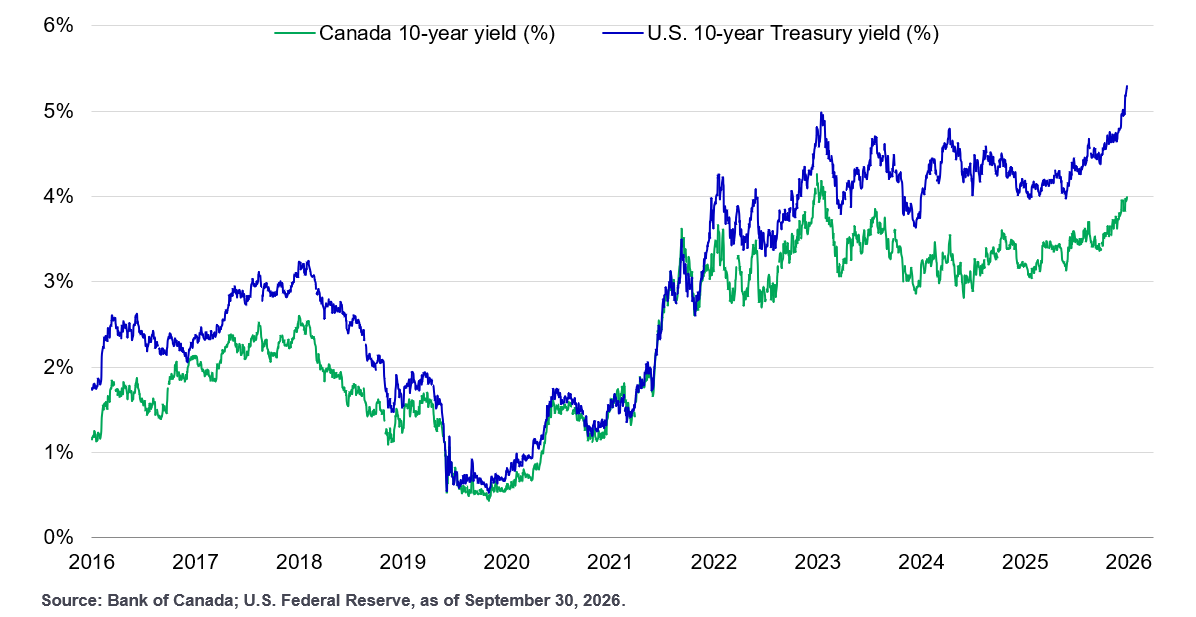
In the U.S., 5-year and 10-year Treasury yields moved above 5% following stronger-than-expected September business activity data, reaching their highest levels since 2007. Canadian government bond yields also rose as part of the broader global move higher in long-term rates.
The move was painful for bond prices, but higher yields give investors a better starting point for income and potential future returns. We think that the trade-off between better income and continued price volatility will remain important in the months ahead.
Canada and U.S. 10-year government bond yields
What to watch
There's no shortage of potential market catalysts as we head toward year-end. We continue to believe that economic growth can support company earnings, but if growth and inflation stay firm, interest rates may also remain higher for longer. Investors may want to consider monitoring the following themes:
- Following the Fed’s September increase, we’ll be watching to see whether this was a one-time adjustment or the start of another phase of tightening. Similarly, for the Bank of Canada, investors will be monitoring economic conditions and inflation developments to assess the potential path of future interest rate decisions.
- The U.S. midterm elections take centre stage on November 3. We'll be paying attention to what it could mean for fiscal priorities, trade and regulatory policy, and the administration’s ability to advance its agenda. Election-related headlines can create short-term volatility, but we don't believe portfolios should be positioned around a single political outcome.
- Corporate earnings will be another important test. With bond yields elevated, investors may be less willing to pay high valuations in the absence of clear earnings results. We’ll be looking to see whether earnings growth broadens beyond the largest technology companies, and whether the significant spending on AI, data centres, semiconductors and power infrastructure begins to translate into stronger revenue and productivity.
- We're also watching what's driving long-term bond yields. Central-bank policy matters, but it's not the whole story. Heavy government borrowing, rising corporate issuance, global demand for duration, energy prices, and fiscal and political uncertainty can all influence yields. If these forces keep term premiums elevated, longer-term rates may remain high even if central banks eventually pause.
- For Canadian investors, trade policy and energy prices deserve particular attention. New trade measures could affect exports, business investment, supply chains and consumer prices. At the same time, sustained strength in energy prices could support parts of the Canadian equity market while adding pressure to inflation, household budgets and corporate margins.
Bottom line: This remains an environment where balance matters. Higher bond yields have improved the income available from fixed income, but rate volatility may stay elevated. Equity fundamentals remain reasonably supportive, but valuations and market concentration leave less room for disappointment. In this environment, investors may wish to review whether their portfolios remain appropriately diversified across asset classes, regions and investment styles, having regard to their individual objectives, time horizon and risk tolerance.
Monthly lookahead
October 4 | Canada September employment, U. of Michigan consumer sentiment |
October 14 | U.S. September CPI, Canada August building permits |
October 15 | U.S. September retail sales, Philadelphia Fed Index, Canada August wholesale trade |
October 19 | Canada September CPI |
October 20 | U.S. September housing starts and building permits, pending home sales |
October 23 | Canada August retail sales |
October 28 | Bank of Canada rate decision, U.S. FOMC rate decision |
October 30 | Canada August GDP |
Important disclosure
The S&P 500 Index tracks the performance of 500 of the largest publicly traded companies in the United States.
The S&P/TSX Composite Index is the benchmark Canadian index that tracks the performance of companies listed on the Toronto Stock Exchange (TSX).
It is not possible to invest directly in an index. Past performance does not guarantee future results.
Investing involves risks, including the potential loss of principal. Financial markets are volatile and can fluctuate significantly in response to company, industry, political, regulatory, market, or economic developments. The information provided does not take into account the suitability, investment objectives, financial situation, or particular needs of any specific person.
All overviews and commentary are intended to be general in nature and for current interest. While helpful, these overviews are no substitute for professional tax, investment or legal advice. Clients and prospects should seek professional advice for their particular situation. Neither Manulife Wealth Inc. nor any of its affiliates or representatives (collectively Manulife Investments) is providing tax, investment or legal advice.
This material is intended for the exclusive use of recipients in jurisdictions who are allowed to receive the material under their applicable law. The opinions expressed are those of the author(s) and are subject to change without notice. Our investment teams may hold different views and make different investment decisions. These opinions may not necessarily reflect the views of Manulife Wealth Inc. The information and/or analysis contained in this material has been compiled or arrived at from sources believed to be reliable, but Manulife Wealth Inc. does not make any representation as to their accuracy, correctness, usefulness, or completeness and does not accept liability for any loss arising from the use of the information and/or analysis contained. The information in this material may contain projections or other forward-looking statements regarding future events, targets, management discipline, or other expectations, and is only current as of the date indicated. The information in this document, including statements concerning financial market trends, are based on current market conditions, which will fluctuate and may be superseded by subsequent market events or for other reasons. Manulife Investment Management disclaims any responsibility to update such information.
Manulife Wealth Inc. shall not assume any liability or responsibility for any direct or indirect loss or damage, or any other consequence of any person acting or not acting in reliance on the information contained here. This material was prepared solely for informational purposes, does not constitute a recommendation, professional advice, an offer or an invitation by or on behalf of Manulife Wealth Inc. to any person to buy or sell any security or adopt any investment approach, and is no indication of trading intent in any fund or account managed by Manulife Wealth Inc. No investment strategy or risk management technique can guarantee returns or eliminate risk in any market environment. Diversification or asset allocation does not guarantee a profit or protect against the risk of loss in any market. Unless otherwise specified, all data is sourced from Manulife Wealth Inc. Past performance does not guarantee future results.
Manulife, Manulife & Stylized M Design, Stylized M Design, Manulife Wealth and Where will better take you are trademarks of The Manufacturers Life Insurance Company and are used by it, and by its affiliates, under license.
5997242